Technology AI News Editor's Choice

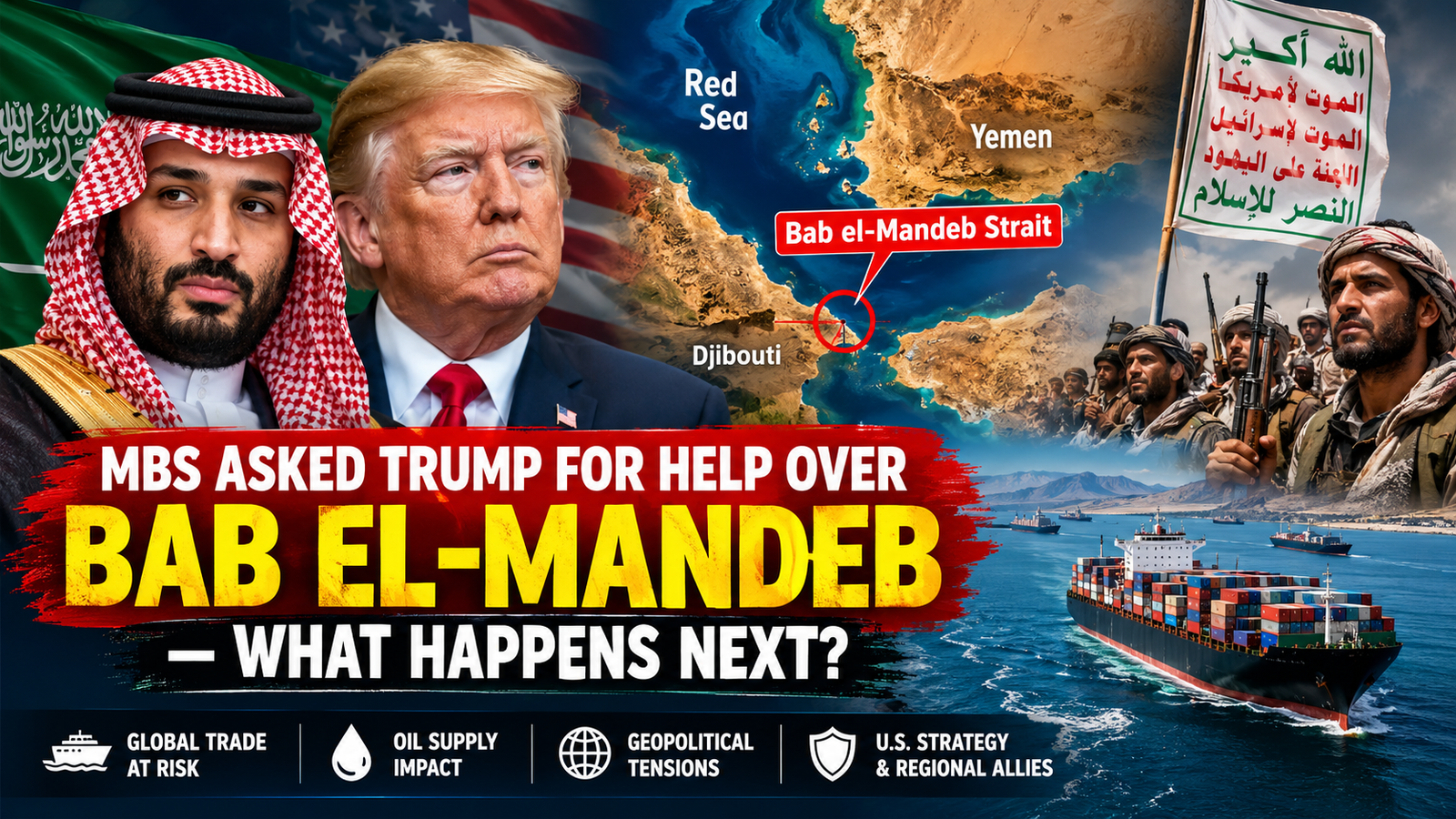
MBS Asked Trump for Help Over Bab el-Mandeb — What Happens Next?

The Bab el-Mandeb Strait is once again at the center of a growing geopolitical crisis, raising difficult questions for Saudi Arabia, the United States, Iran and the future of global shipping.

Arovey Administrator
Administrator & Editor-in-Chief September 13, 2026
5 min read 42 views
Share Story:
MBS Asked Trump for Help Over Bab el-Mandeb — What Happens Next?
MBS Asked Trump for Help Over Bab el-Mandeb — What Happens Next? The Bab el-Mandeb Strait is once again at the center of a growing geopolitical crisis, raising difficult questions for Saudi Arabia, the United States, Iran and the future of global shipping.** The Middle East's geopolitical map is becoming increasingly complicated. From the Strait of Hormuz to the Red Sea, strategically important waterways are turning into pressure points in a wider confrontation involving regional powers and global superpowers. At the heart of the latest debate is **Saudi Crown Prince Mohammed bin Salman (MBS)**, U.S. President Donald Trump, Iran-backed Houthi forces in Yemen, and the strategically critical **Bab el-Mandeb Strait**. According to the analysis presented by Tariq Pathan of Tariq Pathan Science Academy, MBS sought U.S. assistance as the security situation around Yemen's western coastline deteriorated. The video claims that Saudi Arabia wanted stronger American military action against Houthi forces, but Washington was unwilling to launch direct airstrikes. That reported position creates a much larger strategic question: **If the United States does not directly intervene in Yemen, how will Saudi Arabia protect its western maritime interests—and what happens if the Bab el-Mandeb Strait becomes increasingly vulnerable?** ## What Is Happening Around Bab el-Mandeb? The **Bab el-Mandeb Strait** is one of the world's most important maritime chokepoints. Located between Yemen on the Arabian Peninsula and Djibouti and Eritrea on the African side, the strait connects the **Red Sea with the Gulf of Aden and the wider Indian Ocean**. Its geographical position gives it enormous economic and military importance. Ships traveling between Europe and Asia through the Suez Canal generally depend on the Red Sea route. If vessels cannot safely pass through the Bab el-Mandeb, they may have to take a much longer route around the southern tip of Africa. That means instability in Yemen can quickly become a global economic problem. The crisis is therefore not simply about Yemen. It is about **energy security, international shipping, supply chains, insurance costs, European trade and the strategic competition between Iran, Saudi Arabia and the United States.** ## Why Is Saudi Arabia So Concerned? For Saudi Arabia, the situation has an additional dimension. The kingdom sits between two major maritime approaches: the **Persian Gulf and the Red Sea**. The eastern side is closely connected to the Strait of Hormuz, another critical chokepoint through which a major portion of global energy supplies passes. The western side leads toward the Red Sea and Bab el-Mandeb. This creates a strategic dilemma. If Saudi Arabia faces serious disruption in both directions, its ability to move energy and commercial goods through maritime routes could become significantly more complicated. Saudi Arabia has invested heavily in infrastructure designed to reduce its dependence on a single export route. One important example is the **East-West Petroline**, which allows crude oil to move from the eastern oil-producing regions toward the Red Sea port of Yanbu. But pipelines alone cannot solve the entire problem. Oil eventually has to reach international markets, and shipping lanes must remain sufficiently secure. This is why developments around Yemen's western coastline matter so much to Riyadh. ## MBS and Trump's Reported Conversation The central claim discussed in the video is that **Mohammed bin Salman sought help from Donald Trump** as Houthi pressure around strategically important areas increased. The reported request is significant because Saudi Arabia and the United States have maintained a long-standing security relationship. For decades, Washington and Riyadh have cooperated on defense, intelligence, energy security and regional strategic issues. However, cooperation does not necessarily mean that the United States will automatically enter every regional conflict. According to the video analysis, Trump rejected the idea of direct American airstrikes against the Houthis. Instead, the United States was described as being more willing to provide forms of indirect assistance, such as intelligence, targeting information and other non-combat support. If this approach continues, it would represent an important message: **Washington may support Saudi security interests without wanting to become directly responsible for another prolonged military campaign in Yemen.** ## Why the Houthis Matter The Houthis, formally known as Ansar Allah, emerged as a powerful political and military movement in Yemen. The group has received varying forms of support from Iran, although the exact scale and nature of Iranian assistance has been a subject of continuing debate. The Houthis became internationally prominent during the Yemen civil war and later gained even greater attention because of attacks involving missiles and drones. Their geographical position is especially important. The movement operates from territory overlooking the Red Sea and has demonstrated an ability to threaten maritime traffic in the region. This gives the group something more valuable than territory alone: **geographic leverage.** A relatively weak non-state actor can create enormous economic consequences if it possesses the ability to threaten a major international shipping corridor. ## The Importance of Mokha, Dhubab and Mayyun Island The video's analysis highlights reported Houthi advances around several strategically important locations, including **Mokha, Dhubab and Mayyun Island**, also known as Perim. These locations matter because of their proximity to Bab el-Mandeb. Mokha is a historic Yemeni port on the Red Sea coast. Dhubab lies close to the strait, while Mayyun Island occupies a strategically significant position inside Bab el-Mandeb. Control or influence around these locations could provide military forces with valuable observation and operational advantages. However, battlefield developments in Yemen can be fluid, and individual claims about territorial control should be treated carefully unless confirmed by multiple reliable sources. The broader strategic point remains clear: **Any military force capable of threatening traffic near Bab el-Mandeb can potentially influence international commerce far beyond Yemen.** ## Why Bab el-Mandeb Is Called a Global Chokepoint A maritime chokepoint is a narrow passage through which a large volume of international shipping must travel. Bab el-Mandeb is one of the world's best-known examples. The name is commonly translated as **"Gate of Tears"** or **"Gate of Lamentation."** Its importance comes from geography. Ships moving from the Indian Ocean toward the Red Sea must pass through this region. From the Red Sea, vessels can continue toward the Suez Canal and then into the Mediterranean. This creates a maritime connection between: **Asia → Indian Ocean → Bab el-Mandeb → Red Sea → Suez Canal → Mediterranean → Europe.** If this chain is disrupted, the consequences can extend across continents. Shipping companies may reroute vessels around Africa, adding significant distance, fuel consumption and travel time. Those additional costs can eventually reach consumers through higher transportation expenses and increased prices. ## The European and Asian Connection The crisis is particularly important for Europe and Asia. European economies depend heavily on international supply chains connecting them with Asian manufacturing centers and energy markets. Asian economies, meanwhile, are major importers of energy and exporters of manufactured goods. A prolonged disruption around the Red Sea can therefore create a two-sided problem. European companies may face: * Longer shipping routes * Higher freight costs * Supply-chain delays * Increased insurance premiums * Greater energy-market uncertainty Asian exporters can also face longer delivery times and higher transportation expenses. This demonstrates why a conflict thousands of kilometers away can eventually affect businesses and consumers around the world. ## Why Trump May Be Reluctant to Enter Yemen The most important political question is perhaps not what Saudi Arabia wants, but **what Washington is willing to do.** The United States has significant military capabilities in the Middle East. However, military capability does not automatically translate into political willingness. Yemen has already demonstrated how difficult regional conflicts can become. A limited air campaign can develop into a prolonged confrontation. Strikes can trigger retaliation, attacks on shipping can increase, and American forces or regional allies can become targets. For Washington, this creates a difficult calculation. Should the United States: **Option 1:** Conduct direct strikes against Houthi positions? **Option 2:** Provide intelligence and defensive support while allowing regional partners to lead? **Option 3:** Focus its military resources on the larger confrontation with Iran and maritime security around the Strait of Hormuz? Each option carries risks. ## The Saudi Strategic Dilemma Saudi Arabia now faces a difficult balancing act. On one side, Riyadh wants to protect its borders, infrastructure, energy exports and maritime interests. On the other, expanding military involvement in Yemen could reopen memories of the kingdom's costly intervention in the conflict. Saudi Arabia has increasingly emphasized diplomacy and regional stabilization in recent years. That makes a renewed large-scale military campaign politically and economically complicated. The kingdom therefore has several possible strategies. ### 1. Strengthen Local Yemeni Forces Saudi Arabia could provide additional military, financial and logistical support to forces opposing the Houthis. The objective would be to prevent the Houthis from establishing uncontested dominance over strategically important Red Sea territory. ### 2. Increase Maritime Security Saudi Arabia and its partners could strengthen surveillance, naval patrols, air defense and protection for commercial shipping. The objective would not necessarily be to defeat the Houthis completely, but to make attacks on shipping more difficult. ### 3. Pursue Diplomacy Diplomacy remains another important option. Saudi Arabia has previously demonstrated that it is willing to engage with regional rivals when doing so can reduce security risks. Dialogue involving Iran could potentially help manage tensions, although negotiations over Yemen's security architecture are extremely complicated. ### 4. Depend More on International Cooperation Saudi Arabia could also seek greater cooperation from the United States, European countries and other maritime powers. Rather than asking Washington to fight the Houthis alone, Riyadh could support a broader international effort focused specifically on freedom of navigation and protection of commercial shipping. ## The Bigger Iran-Saudi Arabia-U.S. Equation The Bab el-Mandeb crisis cannot be separated from the broader competition involving **Iran, Saudi Arabia and the United States**. Iran has built relationships with several non-state actors across the Middle East, creating what analysts often describe as a network of aligned groups. The Houthis are an important component of this regional security equation. For Iran, pressure on Red Sea shipping can create strategic leverage without requiring a conventional war between Iranian and American forces. For Saudi Arabia, however, the same strategy creates direct economic and security concerns. For Washington, the challenge is preventing disruption to global commerce while avoiding a conflict that could expand across the region. This is why Bab el-Mandeb has become much more than a geographical location. It is now a **symbol of the wider struggle over regional power and global maritime security.** ## What Happens Next? The future of Bab el-Mandeb will depend on several factors. The first is the military balance inside Yemen. The second is the willingness of Saudi Arabia and other regional governments to confront the Houthis. The third is Washington's threshold for direct military action. And perhaps most importantly, the fourth is whether diplomacy can prevent the Red Sea from becoming a permanent theater of confrontation. If tensions continue escalating, international shipping companies could increasingly avoid the Red Sea route. That would place additional pressure on global supply chains and increase the importance of alternative routes around Africa. If diplomacy succeeds, however, Bab el-Mandeb could gradually return to being primarily a commercial maritime corridor rather than a military flashpoint. ## Final Analysis: A Crisis Bigger Than Yemen The reported disagreement between MBS and Trump reveals a deeper transformation in Middle Eastern geopolitics. Saudi Arabia wants security guarantees, but Washington increasingly has to decide where and when American military power should be used. The Houthis, meanwhile, possess a geographic advantage that gives their actions international consequences. And Bab el-Mandeb sits directly at the center of this equation. The key lesson is simple: You do not need to control the world's largest army to influence the global economy. Sometimes controlling—or threatening—a narrow piece of geography is enough. For Saudi Arabia, the challenge is protecting its western maritime interests without becoming trapped in another prolonged war. For the United States, the challenge is maintaining freedom of navigation while avoiding unnecessary military escalation. For Europe and Asia, the concern is uninterrupted trade. And for the wider world, the question is whether another major maritime chokepoint will become a battlefield in the expanding geopolitical competition of the Middle East. The answer may determine not only the future of Yemen, but also the cost and security of international trade stretching from Asia to Europe.
Arovey Administrator

Written by Arovey Administrator

Administrator & Editor-in-Chief

Lead administrator and platform manager for Arovey Blogs digital media platform.

Reader Discussion (2)

Malak 2 hours ago

This is a very interesting development because the Bab el-Mandeb Strait is strategically important for both regional security and global trade. If Saudi Arabia is seeking U.S. support, the response could have wider consequences for shipping routes, energy markets, and the balance of power in the region. It will be interesting to see what steps Washington and Riyadh take next.

Muhammad owais Khan 2 hours ago

Allah dy khair okey

Leave a Reply

Your email address will not be published. Required fields are marked *